


The Battle for Eyeballs: AI Search vs. Traditional Organic Traffic

September 16, 2026

The year 2026 has brought the biggest paradigm shift to the internet since the commercialization of smartphones. For over two decades, search engine optimization (SEO) followed a predictable rulebook: a user typed a query into Google, Google displayed ten blue links, and the user clicked on a link to visit a website.


Today, that model is fundamentally broken. The meteoric rise of AI answer engines—such as Perplexity AI, OpenAI’s SearchGPT, Google’s Gemini-powered Overviews, and Microsoft’s Copilot—has fundamentally changed user habits. Instead of looking through a list of links, users now get direct, hyper-summarized answers written by AI.


For brands operating in 2026, this raises an urgent, existential question: Is traditional organic search traffic dead? How do you get traffic when AI answers the user’s question directly on the search page?


At Weeb Innovation,  we have been analyzing these shifting digital algorithms closely. In this deep-dive guide, we break down the critical differences between AI Search Engine Optimization (GEO) and traditional Organic SEO, and explain exactly how to safeguard your website's traffic.


Understanding the Core Difference


To win the digital game in 2026, you must understand how these two traffic sources operate:


  1. Traditional Organic Search (Google SEO): Driven by keyword matching, backlink profiles, domain authority, and structured indexation. The goal is to rank #1 to get a direct click to your website.
  2. AI Search Engines (Generative Engine Optimization - GEO): Driven by semantic understanding, natural language context, brand citations, and factual accuracy. The AI synthesizes information from across 50 different websites and spits out a unified answer, citing only 3 to 4 source links.


Why Traditional Click-Through Rates (CTR) Are Dropping

Why Traditional Click-Through Rates (CTR) Are Dropping

With AI engines offering direct answers (Zero-Click Searches), websites that rely on basic informational content (e.g., "What is digital marketing?" or "How to calculate compound interest") are seeing their organic traffic plummet by up to 40-60%. Users no longer need to click into your website to read a simple definition because the AI tells them instantly.


However, this does not mean web traffic is dead. It means the type of traffic is shifting from high-volume, low-intent clicks to low-volume, high-converting buyers.

Deep Comparison: Traditional SEO vs. AI GEO

Feature Traditional Organic AI Search Engines (GEO)
User Intent Fragmented keywords (e.g., "best web designer Delhi") Conversational queries (e.g., "Find an agency near me specializing in custom Node.js sites with 5-star reviews")
Ranking Algorithm Backlinks, Keyword Density, Meta Tags, PageSpeed Citation Authority, Semantic Trust, Factual Accuracy, E-E-A-T
Traffic Characteristics High volume, but higher bounce rates Lower volume, but incredibly high buying intent
User Experience Scrolling through a sea of sponsored ads and links Single, direct, multi-paragraph synthesized answers

The 2026 Strategy: How to Make AI Engines Cite Your Website

If you want Weeb Innovation or your personal brand to show up as the primary "Source Citation" link inside ChatGPT, Gemini, or Perplexity, you must alter your content writing strategy immediately using these four rules:


1. Double Down on First-Party Data & Original Opinions


AI models already know every public textbook fact on the internet. They do not need your blog if it just repeats what is on Wikipedia. To stand out, your content must contain unique insights:


  • Conduct original industry surveys and publish raw statistical data.
  • Write detailed, brutally honest case studies showing real numbers, failures, and custom frameworks.
  • Share strong, expert opinions on industry trends that an AI cannot easily replicate.


2. Implement Flawless Technical Schema Markup


AI crawlers do not read pages like humans do; they parse code looking for explicit, structured data points. By embedding advanced Schema markup (like Organization Schema, Product Specification Schema, and FAQ Schema), you make it incredibly easy for an AI model to pull your data points and present them to the user with a source link to your site.


3. Optimize for Conversational, Long-Tail Phrases


People do not talk to AI engines using robotic keywords. They type full, multi-sentence paragraphs. Instead of optimizing for "web development costs", optimize your content to answer: "How much does it cost to hire an agency to build a custom React dashboard for a medical clinic in 2026?"


4. Prioritize Brand Sentiment & Off-Page Digital PR


AI search engines do not just scrape your website; they check what Reddit, Quora, LinkedIn, and review portals say about you. If your brand has glowing mentions, high-quality reviews, and professional case studies discussed across the web, AI systems will label your business as a "trusted authority" and actively recommend you in conversational search results.


Conclusion: The Future of Digital Traffic


Traditional organic traffic is not dying; it is simply maturing. While the era of easy, mindless clicks from basic keyword stuffing is officially over, the era of high-value, high-intent traffic has arrived.


By building a highly authoritative, technically sound, and deeply human website, you ensure your business is recommended by AI engines rather than hidden by them.


Navigating this massive shift can be incredibly overwhelming for established brands. At Weeb Innovation, we specialize in cutting-edge Generative Engine Optimization (GEO) and advanced SEO strategies tailored for 2026. Contact our strategic growth team today, and let’s turn the AI revolution into your biggest competitive advantage!

October 13, 2026
Both options offer valuable benefits. The right choice depends on the size of the business, customer expectations, and the types of inquiries received. How AI Chatbots Can Help Increase E-Commerce Sales Customer support is not just about solving problems. It can also influence purchasing decisions. When customers receive timely information, they may feel more confident about completing their orders. For example, imagine a shopper visiting an online clothing store who is unsure about product size, delivery charges, or return options. Instead of leaving the website to search for answers, the shopper can ask a chatbot and receive immediate assistance. An effectively configured chatbot can help businesses: Reduce customer waiting time. Assist shoppers during product selection. Answer common checkout questions. Provide product recommendations. Improve the overall shopping journey. Reduce avoidable cart abandonment. However, results depend on chatbot accuracy, website integration, and the quality of the customer experience. The Smartest Approach: Combining AI Chatbots with Human Support For many online businesses, choosing only one customer service method may not be the most effective strategy. A hybrid customer support model combines the speed of AI chatbots with the personal attention of human agents. Here's how it works: Step 1: AI Handles Basic Questions A chatbot responds to routine questions about products, shipping, payment methods, store policies, and order tracking. Step 2: Complex Issues Are Identified When a customer needs additional assistance or the chatbot cannot confidently resolve an issue, the conversation is transferred to a human representative. Step 3: Human Agents Provide Personalised Solutions Support employees handle complicated complaints, unusual requests, and sensitive customer concerns. Step 4: Businesses Improve Support Quality Customer feedback and conversation trends help businesses identify common problems and improve their support processes. This approach can improve efficiency without sacrificing the human connection customers value. How to Choose the Right Customer Support Solution Before investing in customer support technology, online store owners should consider several factors. Business Size: Small online stores may begin with basic automated chat support, while larger businesses may require advanced AI tools and dedicated support teams. Customer Requirements: Businesses receiving mostly repetitive questions can benefit from automation. Stores dealing with highly customised products or complicated services may need more human involvement. Budget: Compare chatbot subscription fees, setup costs, maintenance expenses, and human staffing requirements. Integration: Choose tools that work with your e-commerce website, CRM, order management system, and existing communication channels. Data Security: Make sure your customer support solution protects customer information and follows applicable privacy requirements. The Future of Customer Support in E-Commerce Customer service technology continues to evolve as AI becomes more capable. In 2026, online businesses can explore AI-powered tools that support multilingual conversations, personalised product discovery, automated ticket classification, and smoother transfers between chatbots and human agents. However, automation should not come at the expense of customer satisfaction. Businesses that focus on accurate information, transparent communication, privacy, and easy access to human assistance will be better positioned to build lasting customer relationships. How Weeb Innovation Can Help Your Online Business Grow At Weeb Innovation , we believe successful e-commerce businesses need more than an attractive website. They need a digital experience that makes shopping simple, convenient, and trustworthy. A well-designed online store, supported by smart technology and effective customer communication, can help businesses improve customer engagement and create more opportunities for growth. Whether you're launching a new e-commerce website or improving an existing online store, choosing the right digital solutions is an important part of building a successful online presence. Final Thoughts AI chatbots and human customer service both play important roles in modern e-commerce. Chatbots provide speed, availability, and automation, while human representatives offer empathy, flexibility, and personalised problem-solving. For most growing online stores, combining AI automation with reliable human assistance offers a practical balance between efficiency and customer satisfaction. The future of e-commerce customer support is not simply about replacing people with technology. It's about using technology to help businesses serve their customers better. Want to create a smarter, more customer-friendly online store? Connect with Weeb Innovation and explore digital solutions designed to support your business growth.

October 8, 2026
Compare Duda Website Builder and custom development for agencies and mid-sized brands, covering performance, scalability, costs, flexibility, and long-term growth.
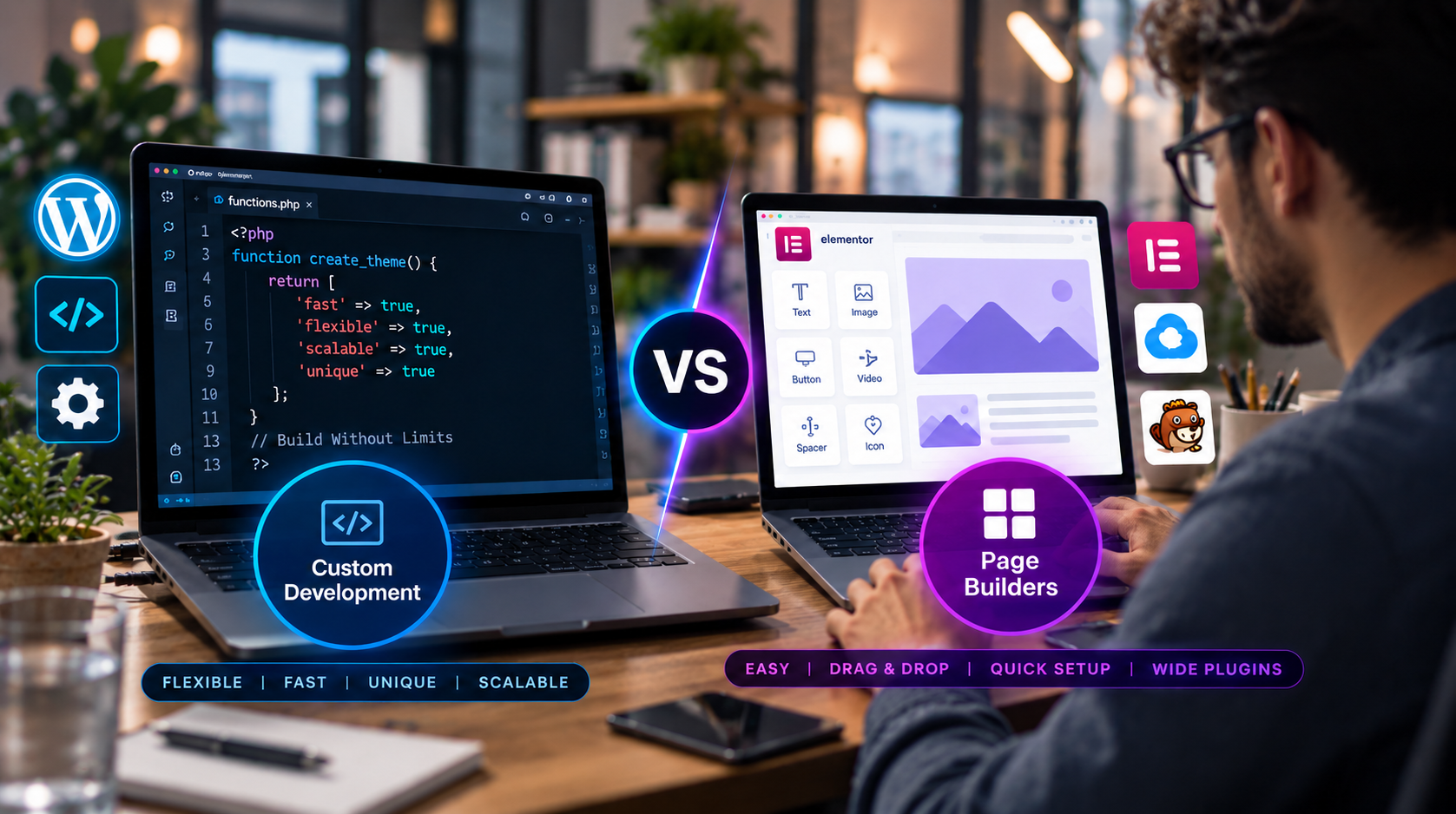
Two laptop screens comparing WordPress code and a visual website builder in a modern office
October 6, 2026
Compare WordPress page builders like Elementor, Divi, and Bricks with custom themes to understand flexibility, performance, scalability, and development needs.

Person wearing a headset works at a desk with multiple monitors displaying code and a laptop.
October 1, 2026
Explore the pros, cons, and real-world limitations of AI website builders for established brands, including scalability, security, customization, and brand identity.

Person checking a digital checklist on a laptop with a stylus at a desk
September 29, 2026
Use this complete 2026 website launch checklist to review SEO, forms, security, performance, mobile responsiveness, and other essential pre- and post-launch tasks.

Share